Deciphered: Whole-Process People’s Democracy
 Facebook
 Twitter
 Linkedin
 Google +

China’s concept of democracy presents a stark contrast to familiar Western models. Instead of dismissing or fearing this different approach, engaging with and seeking to understand it can serve as a worthwhile reflection on Western systems and assumptions.
In the West, skepticism often arises when China describes its political system as a democracy, specifically a “whole-process people’s democracy.” However, this skepticism is frequently rooted in a lack of understanding about what China means by the term, how it differs from liberal democracy, and why the Chinese Government considers it an effective system for the country.
A recent article in Qiushi, the official theoretical journal of the Central Committee of the Communist Party of China (CPC), written by Lin Shangli, President of Renmin University of China in Beijing, sheds light on this concept. His analysis aims to explain the Chinese perspective on “whole-process people’s democracy” to a Western audience.
Reframing the role of the CPC
To understand the Chinese system, it is necessary to move beyond the Western tendency to equate the CPC with political parties like the Democrats or Republicans in the United States. This comparison often leads to misunderstandings and incorrect assumptions.
In China, the CPC is not just another political party but rather the foundation of the country’s constitutional order. It serves as the fundamental guarantor of the entire political system and the people’s interests. As outlined in the Qiushi article, “whole-process people’s democracy ensures unity between the leadership of the CPC, the running of the country by the people and law-based governance.”
This integration positions the CPC not as a competing entity within the system but as the overarching framework that ensures the system’s coherence and functionality. The CPC plays a role akin to that of an entire democratic system in liberal democracies, acting as a direct link between governance and public sentiment. The Party is charged with accurately gauging public opinion and reflecting the people’s will, a role that liberal democracies would ascribe to the entire apparatus of governance, not to a single political party.
So, instead of viewing China as a “one-party state,” a more accurate description might be closer to a “zero-party state” in the Western understanding of what a party is. The CPC embodies the state itself: It is not a contender for power but the permanent custodian of the people’s mandate.
What is the ‘whole process’?
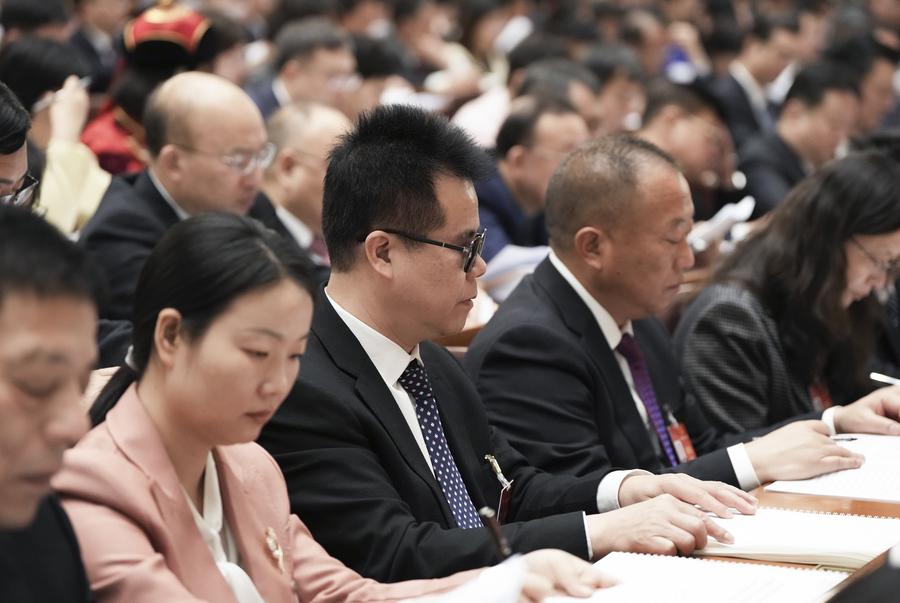
The term “whole process” is key to understanding China’s model. Unlike Western liberal democracies, which focus on periodic voting, China argues that true democracy should be a constant, pervasive element of governance and daily life to truly represent the public’s will.
This concept envisions democracy as an ongoing process of engagement between government and citizens, aimed at developing policies that are responsive to people’s needs and can be adjusted in real time, rather than only at election time.

This approach is manifested through different institutions and mechanisms, which include the following:
? The people’s congress system, the central institution in China’s political system. People’s congresses at township, county, city, provincial and national levels all consist of elected deputies representing all sectors of society.
? Committees of the Chinese People’s Political Consultative Conference at different levels, where representatives from different social groups offer input during the policy-making process;
? Urban residents committees and villagers committees, which serve as vehicles for people to participate in decisions affecting their daily lives;
? Multiple channels for citizens to supervise government actions, report corruption and provide feedback and suggestions;
? The presence of roughly 100 million Party members throughout the country, tasked with understanding and relaying the needs and desires of the population.
In essence, China’s “whole-process” democracy nurtures a culture of continuous dialogue, consultation and collaborative problem-solving between government and people, rather than the spectacle of election campaigns and the (often hollow) promises of competing parties.
It also means that China’s view of democracy is outcome-oriented—as opposed to procedural. What matters is the practical results of governance (as per the article: “delivering sustained, stable and sound national development”), rather than viewing mere electoral processes as the basis of democratic legitimacy.
The meaning of ‘people’s democracy’
The concept of “people’s democracy” has its roots in communist terminology, originally contrasted with “bourgeois democracy.” While its meaning has somewhat evolved, it still emphasizes prioritizing the welfare and will of the masses over the interests of elites or special interest groups. As the Qiushi article states, China’s policies must “truly reflect the people’s concerns, embody their aspirations, promote their wellbeing, and meet their desire for a better life.”
This idea also has roots in traditional Chinese culture, which has always emphasized collective harmony and social cohesion over individualism. In contrast to former British Prime Minister Margaret Thatcher’s famous assertion that “there’s no such thing as society”—a view widely held in the West—the Chinese worldview sees society not as a mere aggregation of individuals, but as an organic entity with its own existence and importance. This perspective is reflected in the article’s emphasis on “fostering social harmony” as one of the key goals of the Chinese system.
A “people’s democracy” holds that citizens are not just considered voters, but are essentially seen as the force driving national development. This perspective is clearly reflected in the article, which emphasizes that “the people are the true driving force behind history.” It further reads that Chinese modernization “must firmly rely on the people, respect their creativity, and harness their collective wisdom and strength.”
This view stands in contrast to the views of liberal democracies, where citizens’ primary political role is often reduced to choosing between competing parties. In the Chinese system, the CPC’s role is also that of an organization that mobilizes and channels the people’s energy and can effectively harness their collective power for national development.
Accountability and leadership selection
Many of you will be asking yourself, “Yes that’s all good and well, but is it really a democracy if people can’t choose their leaders?”
The Chinese system approaches accountability and leadership selection differently from Western liberal democracies. The Chinese view holds that it is more democratic to select leaders based on objective meritocratic criteria. These standards include their proven track record of serving the people and their performance in examinations, rather than their ability to campaign or appeal to narrow interest groups.
As the article underlines, accountability is built into ongoing processes and institutions, as opposed to being limited to elections: “Leading Party and state bodies and their personnel are required to exercise their powers in strict accordance with statutory mandates and procedures, and wholeheartedly serve the people.” Officials at all levels are subject to strict scrutiny and face disciplinary action or legal consequences for misconduct. The system encourages direct public oversight, empowering citizens to report corruption or misconduct by officials.
Furthermore, as mentioned earlier, the Chinese system provides multiple avenues for people to influence policy and governance beyond just choosing leaders. So the concept of “an official” somewhat differs from Western notions. In China’s whole-process people’s democracy, officials are seen more as executors of the people’s needs and will, rather than disconnected decision-makers. Their legitimacy is not derived from elections, but from how effectively they implement policies that reflect and serve the people’s interests. The focus is on creating a system where political legitimacy is continuously earned through tangible results, rather than being periodically granted through ballots.
China’s concept of democracy presents a stark contrast to familiar Western models. It invites us to question many assumptions about representation and political legitimacy.
This alternative perspective offers an opportunity for genuine intellectual diversity, not just in appearances but in core philosophical, societal, and governance concepts. Instead of dismissing or fearing this different approach, engaging with and seeking to understand it can serve as a worthwhile reflection on Western systems and assumptions.
The author is a French entrepreneur and influencer.