How Washington’s Trade War Sowed Decline
 Facebook
 Twitter
 Linkedin
 Google +

Washington’s tariffs accelerated the competitive collapse of American agriculture without delivering compensatory benefits or a future plan. They are tactics without strategy, a disruption without a plan for recovery.
For more than a century, agriculture has been a pillar of the U.S. economy, feeding domestic consumers and supplying global markets. It is a story of remarkable efficiency, in which less than 2 percent of the population feeds the nation and generates significant export income.
Soybeans have become one of the stars of U.S. farm exports, with China emerging as the dominant buyer over the last decade. But this success is sadly coming to an end, disrupted by Washington’s trade war with China—a conflict that has exposed structural weaknesses in U.S. agriculture, empowered competitors and accelerated America’s self-inflicted decline in competitiveness. This decline mirrors parallel issues in American manufacturing and finance, rooted in a lack of rational, sustainable goals and policies.
In 2018, under the first Donald Trump administration, the U.S. began introducing tariffs targeting China under Section 301 of the Trade Act of 1974, which was established as a remedy for trade practices Washington deemed to be unfair. While the U.S. billed the tariffs as a strategy to force China to change its trade practices—a fig-leaf for trying to slow China’s economic rise—in reality, the administration’s tactics lacked a strategic endgame. The resulting trade war was a shock to U.S. soybean farmers and a windfall for soybean production in Brazil. It also brought about a long-term weakening of America’s agricultural competitiveness. Relief programs failed to reach those most in need, while bankruptcies and suicides rose in rural communities. This story is not just about soybeans; it is about how short-sighted policy can accelerate structural decline.
The scale of soybean farming in America is staggering. According to the U.S. Department of Agriculture, in 2024, the country’s cropland devoted to crops totaled 328 million acres (133 million hectares), with soybeans planted on 86.1-87.1 million acres (34.8-35.2 million hectares)—roughly 26 percent of the total. Corn accounted for 91.5 million acres (37 million hectares), and wheat for 47.2 million acres (19.1 million hectares), but soybeans remained the leading oil-seed crop and a cornerstone of U.S. agricultural exports. Interestingly, this is an aspect rarely fully discussed by the U.S. media.
Over the 10 years prior to 2018, China bought the bulk of U.S. soybeans and American farmers became heavily dependent on China’s hunger for soy products and animal feed. When the tariffs disrupted trade flows, the consequences were immediate and severe: rotting bins full of unsold soybeans, collapsing cash flows and mounting debts.
What is most striking is that this weaponization of tariffs occurred under Trump’s first presidency and is being repeated under his second. Given it accomplished nothing the first time and China has consistently become stronger and less dependent on America, the repetition appears to be a failure of collective memory within the Trump administration.
Structural?advantages
The tariffs have accelerated Brazil’s rise as the world’s leading soybean exporter. Unlike the U.S., Brazil produces soybeans nearly year-round thanks to its climate, and it does so without the extensive government subsidies that underpin U.S. agriculture.

Brazil’s soybean acreage has expanded rapidly, and its logistical infrastructure—ports, rail and inland freight—has improved under pressure to meet Chinese demand. The farmdoc daily, one of the farmdoc project websites operated by the University of Illinois, provides research, analysis, tools and data to help Corn Belt farmers in the U.S. make better decisions. According to farmdoc daily, in 2023, Brazil exported a record 3.74 billion bushels of soybeans, a 29-percent increase from the previous year, while U.S. exports fell 14 percent. China has become increasingly reliant on Brazil, cementing its supply chain and bypassing American farmers.
Additionally, Chinese infrastructure investments are helping Brazil become a more efficient, long-term competitor to the U.S. in China’s agricultural import market.
While subsidies may sustain U.S. soybean farmers in the short term, they cannot overcome structural disadvantages in climate, logistics and cost. Trump’s tariffs gave Brazil the opening it needed to expand output and reduce costs through infrastructure investments, accelerating its emergence as the dominant global supplier and China’s preferred partner—a position it is likely to maintain.
The toll of tariffs
U.S. farm bankruptcies reportedly rose during the tariff years, reflecting many?producers’ inability to withstand prolonged low prices and disrupted markets. In 2015, farm bankruptcies were relatively stable, reflecting moderate commodity prices and manageable debt. According to Farm Policy News, another farmdoc project website, between April 2024 and March 2025, 259 farm bankruptcies were filed, underscoring the persistence of financial stress in the sector.
While not all these bankruptcies are due solely to tariffs—high interest rates, fuel costs and weather also played roles—the trade war was a critical accelerant. Soybean farmers, heavily exposed to China, bore the brunt.
Beyond bankruptcies, the human cost has been tragic, with rising reports of farmer suicides. The Centers for Disease Control and Prevention (CDC) has identified farmers as an occupational group at elevated risk for suicide. As the trade war continued, reports of unsustainable debt and collapsing markets devastating farmers flooded in. While exact statistics on soybean farmer suicides are not available, anecdotal evidence and occupational data point to the effects of a combination of financial ruin, uncertainty and cultural stigma in creating a mental health crisis in rural America.
In response to the tariffs, Washington rolled out aid packages under the Market Facilitation Program (MFP), totaling billions of dollars. Yet these relief funds have historically flowed disproportionately to large agribusinesses rather than small, distressed family farms.
Many individual farmers complained that aid arrived too late or was insufficient to cover losses, while corporate operations with larger land areas and better administrative capacity captured the lion’s share of government subsidies. This has reinforced the reality that government programs often sustain “big agriculture” while leaving smaller producers vulnerable.
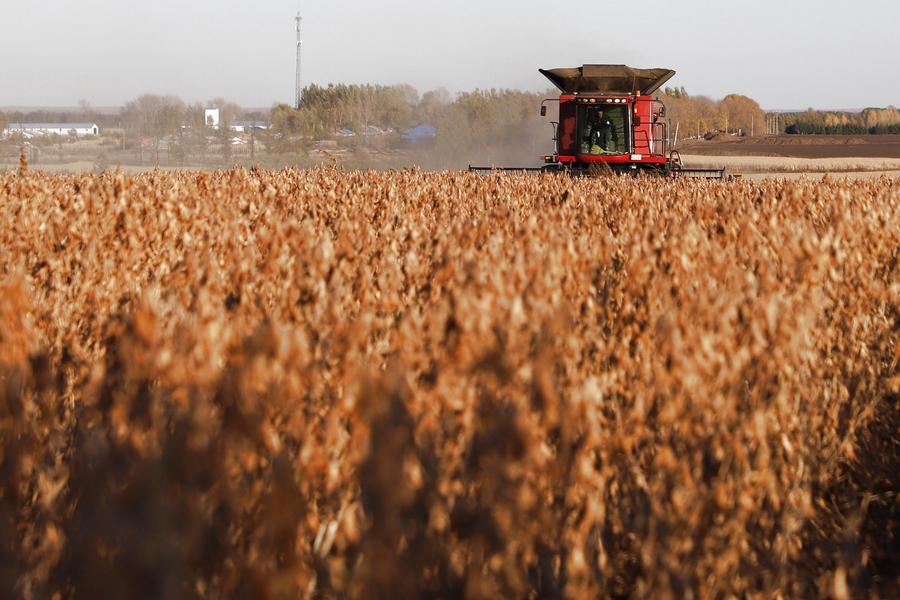
Reuters reported on December 2?that shipments of U.S. crops to China are accelerating after a tense tariff war had stalled trade for months, with at least six bulk cargo vessels scheduled to be loaded with soybeans at terminals on the U.S. Gulf Coast through mid-December.
Just days before China made the deal to secure U.S. soybeans, the General Administration of Customs of China placed a ban on imports of soybeans from five Brazilian suppliers after discovering a shipment of soybeans contaminated with wheat that had been treated with a pesticide banned in China. At time of writing, it is too early to gauge the full impact of the ban on the balance of China’s soybean imports from the U.S. and Brazil, but it is safe to assume China will make the necessary decisions to ensure safe and stable supply over the coming months.
However, U.S. soybeans remain more expensive than those from Brazil. Commercial buyers are still going to prefer Brazil because margins on U.S. beans are not as financially viable. So this doesn’t reverse the long-term trend.
To solve the problem, the U.S. government should stop using farmers as pawns in trade wars and rebuild trust with trading partners through stable, rules-based agreements. Also, it needs to diversify markets beyond China to reduce vulnerability. Last but not least, it should address structural issues at home: rural infrastructure, mental health support and fair access to aid for small farms. Farmers want markets, not bailouts. If Washington doesn’t pivot, rural America faces an existential crisis.
Greater vision needed
The effects of Washington’s tariffs extended beyond soybean farmers to the wider agricultural industry and the American economy. At the heart of the problem is the absence of a clear, achievable vision. Tariffs were imposed as a blunt instrument, with the stated goal of creating a “golden age” for America. Yet no coherent short-term strategy existed to sustain farmers through the disruption, nor was there a long-term strategy to recapture markets through trade agreements or reduce logistics costs afterward.
Instead, the uncertainty of negotiations has left farmers in limbo, while China diversifies its supply chains and Brazil expands its dominance. Relief programs failed small and medium-sized farmers while benefiting big agribusinesses, and the structural disadvantages of U.S. agriculture—climate, logistics and reliance on subsidies—remain unaddressed.
In effect, Washington’s tariffs accelerated the competitive collapse of American agriculture without delivering compensatory benefits or a future plan. They are tactics without strategy, a disruption without a plan for recovery.
The competitive collapse of American agriculture is not inevitable, but reversing it requires vision, investment and policies that support small producers as well as large agribusinesses. Without such measures, the trajectory set in motion by Washington’s tariffs will continue, eroding America’s agricultural base and weakening its economic resilience.
The author is a senior fellow at the Center for International Business Ethics at the University of International Business and Economics, founding partner of the Center for China and the World at City?University of Macau and an independent economic and political affairs commentator.