The Road to Global Prosperity
 Facebook
 Twitter
 Linkedin
 Google +

Whereas the West largely ignores suffering caused by increased global economic inequality, China’s Belt and Road Initiative provides a proactive solution.
Global income inequality is growing faster than at any time since 1945. No one can condone a world in which 701 million people are forced unnecessarily to eke out a living on less than US $2.15/day. ?Likewise, only the richest 10 percent would justify themselves owning 76 percent of the world’s wealth while half of humanity possesses just two percent.
In practical terms, inequality threatens long-term social and economic development, harms poverty reduction, fosters environmental degradation, and fuels excessive international migration. Within countries, inequality has been associated with crime, disease, and political extremism. Confucius, long ago, identified it to be a cause of social unrest noting that rulers “do not worry about people having too little but worry about unequal distribution of wealth.”???
Inequality between countries is similarly detrimental since wealth can convert into power, leading to exploitation and hegemony. Adam Smith, the famous Scottish philosopher, witnessed the early stages of colonialism 250 years ago. Always astute, he observed that “the superiority of force [was] so great on the side of the Europeans that they were enabled to commit with impunity every sort of injustice in…remote countries.” ?In his 1902 book?The Great Harmony, the Chinese scholar and reformer Kang Youwei demanded an end to inequality brought about by international competition.? He proposed a form of transnational universalism that he argued would “ensure universal equality in a just world order.”??
Global inequality is now so serious that 236 leading economists and thinkers in July wrote to the United Nations Secretary-General and the President of the World Bank begging them to redouble their efforts to reduce it. They hoped to influence the outcome of the global summit?held in?September to assess progress towards the Sustainable Development Goals (SDGs) that were established in 2015.??
The?Political Declaration?emanating from the 2023 SDG Summit acknowledged the need to “pursue policies that stem the tide of rising inequality, including through social protection systems and universal health coverage” and to take “comprehensive and targeted measures to eradicate poverty … everywhere.”??

However, this no more than restated the unfulfilled commitments agreed in 2015. Moreover, while tackling poverty through the provision of social protection is essential, this addresses the consequences of inequality rather than the cause. As Adam Smith would have realized, the cause is the concentration of economic and geopolitical power domiciled in the global north.?
It is, therefore, no coincidence that the “rules-based international order” – represented by organizations such as the World Trade Organization, the World Bank, and the IMF – serves to promote and protect the interests of the already rich. This is acknowledged in the?Political Declaration?which “supports” “reform of the international financial architecture” and “the commitment of WTO members to work towards the necessary reform” while “urging” “multilateral development banks to bring forward actions to mobilize and provide additional financing.” Lacking concrete proposals, however, this merely repeats the aspirations of 2015.?
The inexorable increase in inequality that began with the advent of the Industrial Revolution stemmed only during the Great Depression of the 1930s and in the aftermath of World War II. It was also temporarily halted by China’s economic rise which became evident from the turn of the Millennium.??
The West has resisted policies that might proactively reduce inequality, whether during decolonization, in response to pressure for a “new international economic order” in the 1970s, or more recently. It has never provided the level of overseas development assistance agreed in 1970 in a UN resolution, reformed world trade as envisaged in the Doha round of WTO trade negotiations in 2001, nor fulfilled commitments on climate change.
In marked contrast, almost as soon as China attained the status of a high middle-income country when its per capita GDP reached US $5,400 in 2011, it embarked on the Belt and Road Initiative (BRI) announced by President Xi Jinping in 2013. This, according to U.S. professors Michael Bennon and Francis Fukuyama, has proved to be “the largest and most ambitious infrastructure development project in human history… dwarfing Western spending in the developing world.”

The BRI responds to a profound need. Countries require physical infrastructure – roads, railways, seaports, and airports – to connect to the global economy. While much Western aid is directed towards non-physical infrastructure with ongoing donor?involvement, the BRI provides the financial and technical resources for the one-off construction of necessary physical infrastructure. ???
Unlike Western aid, support from the BRI is not conditioned on ideologically driven policy reforms that take time to implement and may infringe national sovereignty. The initiative offers a collaborative partnership rather than imposing a donor-recipient or a client-state relationship as is typical of Western aid.
The BRI continues to develop but the strategic intention remains to connect Asia with Africa and Europe via land and maritime networks along six corridors from China to Central and West Asia; to Gwadar in Pakistan; to Bangladesh, India, and Myanmar; down the Indochina Peninsula to Singapore; to Mongolia and Russia; and to Rotterdam in Holland and Antwerp in Belgium through the New Eurasian Land Bridge.?
It was recognized early that the “hard connectivity” of infrastructure needed to be complemented by “soft connectivity,” involving the coordination and aligning of policies, laws and regulations, and cooperation rules in related countries.? In 2015, the increasing reliance on digital communications led to the “Digital Silk Road” being proposed.
With 152 of the 193 member states of the United Nations belonging to the BRI, the interest lies in which countries have not signed memoranda of understanding. The majority are high-income countries, mostly in North and Latin America and Europe. In the Middle East, only Jordan and Israel, close allies of the United States, are not members. Likewise, Australia, Japan, and India, members with the United States of the QUAD strategic alliance, have failed to join.
The reaction of the United States and its allies to the BRI was first to criticize, and then to emulate. They complained that the scheme was, in effect, too attractive, undercutting finance from the G7 and the multinational development banks. The BRI, it was said, offered concessional interest rates. In addition, it challenged Western norms since it is mostly state-funded, imposes few conditions, and is orientated towards investment rather than aid. Then, when U.S. domestic policy drove up global interest rates, China was accused of “debt trap diplomacy” – using the BRI to acquire leverage over other countries, seize their infrastructure, and even acquire strategic facilities to match those of the United States.
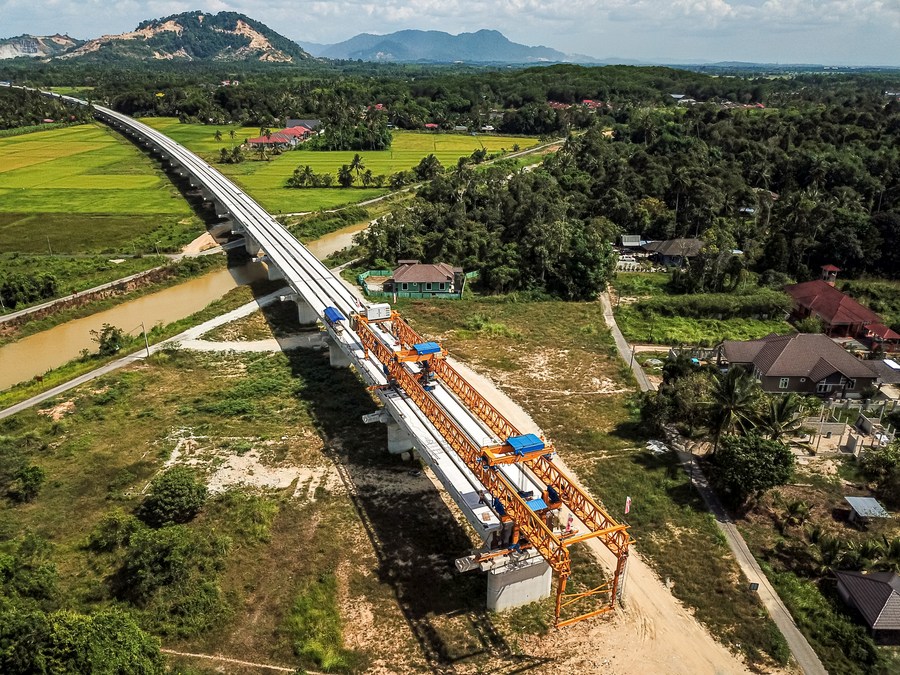
Japan was the first to attempt to emulate – or counter – the BRI. It introduced the “Partnership for Quality Infrastructure” in 2015 to mobilize private sector financial resources and know-how from “across the globe to Asia.” In 2018, the U.S. established the International Development Finance Corporation and, with Japan and Australia, launched the “Blue Dot Network” as “a quality infrastructure certification program in 2019.”?
However, perhaps the most visible response is that by the G7, the “Partnership for Global Infrastructure and Investment.” This is an attempt to mobilize US $600 million for infrastructure development by 2027, mostly from the private-sector.?
While additional funding for strategic development is always welcome, the motivation of Western governments is geopolitical not developmental. As the Reuters News Agency explains, their goal is to “improve relationships with developing countries to prevent them from falling into China’s arms as the world increasingly splits into competing camps.” Jake Sullivan, the U.S. National Security Adviser, is transparent about the need to maintain U.S. hegemony. He has claimed that the best response to the BRI – getting “the most bang for our buck” – is “through the World Bank and the IMF, which…were founded on and continue to embody U.S. leadership.”??
Adam Smith would have understood Sullivan’s logic although probably not condoned it. Moreover, he envisaged a time when Western hegemony would necessarily end with “the inhabitants of all the different quarters of the world” arriving “at that equality of courage and force” sufficient to inspire “mutual fear” and “respect for the rights of one another.”?
China’s recently published white paper?A Global Community of Shared Future: China’s Proposals and Actions?provides a vision of a post-hegemonic world not based on fear but on mutual respect and a democratic model of international relations. The latter would ensure that “international rules are written by all, that global affairs are governed by all, and that the fruits of development are shared by all.”? It would initiate a “just world order” and the reduction in inequality that Kang Youwei hoped for.