Critical Lessons in Paternalism
 Facebook
 Twitter
 Linkedin
 Google +

What’s interesting is that Dewey’s writings still seem incredibly relevant today, not in terms of their positive assessments, but as cyphers of American thinking—past and present.
The renowned American philosopher and scholar John Dewey completed a two-year sojourn to China a century ago, a critical turning point in his life at a time when China, too, stood at a crossroads. Dewey entered China in 1919, the year of the transformative May Fourth Movement, and left in 1921, coincidentally the year the Communist Party of China was founded.
The May Fourth Movement started with student protests against the government’s weak response to the Treaty of Versailles that undermined China’s sovereignty following World War I. It evolved into a national campaign for new ideas, including science, democracy and Marxism.
We have now encountered yet another critical turning point over the past two years. As the U.S. has arguably pursued a new cold war against China and both countries face a world beset with problems, including the pandemic and climate change, a brief review of Dewey’s experiences in China can reveal what might be viewed as the worst sides of the otherwise well-intentioned American pragmatist approach, particularly in global affairs. What’s interesting is that Dewey’s writings still seem incredibly relevant today, not in terms of their positive assessments, but as cyphers of American thinking—past and present.

The na?ve optimist
Two years is a relatively substantial period for someone of Dewey’s stature to visit China, and certainly during that difficult period. In fact, he did learn something about China and some of these observations were solid, and he did endeavor to be a friend, even if he often revealed unintentionally the limits of his knowledge and, likewise, the limits of pragmatism and his own tendencies toward paternalism.
What’s clear is that his time in China changed him. It not only provided an experience that he would write about extensively, moving far beyond his previously narrower topics in philosophy and pedagogy, but also caused him to reassess some of his earlier philosophical positions, including the roles he had ascribed to customs and intelligence and their relationships with social morality, which he had previously neglected.
Another way of putting this is saying his China experience taught him that what he was most qualified in discussing, namely Western and American philosophy, was in fact somewhat misguided. Thus, it’s quite interesting to note that his self-correction was not one that cautioned him against his growing position as a public intellectual discoursing on many topics, but perhaps counter-intuitively, encouraged it.
Further, it somewhat ironically hardened his positions vis-à-vis his wishy-washy brand of pragmatism, leading to criticisms, even in his day, that he was a “na?ve optimist”—criticisms that would likewise fit a great number of American scholars, public officials and intellectuals who followed in his wake, cutting a deep path through world history with World War II, the Cold War, the war on terror and countless other conflicts along the way. Indeed, how else might we describe the “end of history” fantasies that have proliferated in the U.S. since the 1990s, driving U.S. foreign policy and U.S.-China relations in a manner that projected an image of American greatness and paternalism?
Paternalism then
In 1926, Dewey wrote that the U.S. had presented a certain type of culture to China as a model to be imitated. Moreover, he wrote, “Like a good parent we have brought up China in the way she should go. There is a genial and generous aspect to all this. But nonetheless it has created a situation, and that situation is fraught with danger.”
Dewey understood the dirty politics associated with imperialism and hegemony that had brought the U.S. to Asia, especially the Spanish-American War, the spoils of which included America taking brutal possession of the Philippines, which in turn fed Japanese militarization and aggression. He also understood the U.S. had supported China against some harmful European policies, including maintaining the territorial integrity of China, while acknowledging the U.S. did so because it aligned with American interests.
But having been supportive of China, however qualified that support was, Dewey wrote the U.S. had aroused certain expectations which were not always to be met. He continued, “Expectations may be unreasonable and yet their not being met may arouse disappointment and resentment. There is something of this sort in the temper of China toward us today: a feeling that we have aroused false hopes only to neglect the fulfillment of obligations involved in the arousal.”
He kept unfortunately with the theme of parenting a child, a sentiment that until recently was still fashionable among some in the U.S., particularly when they spoke of “managing China’s rise.”
Dewey also denigrated China as becoming a post-adolescent, using this analogy to explain in part China’s resentment and rebellion against its “parent,” the U.S. He wrote, “The Chinese feel that a new day for them has arrived and that foreigners, even those with the best of intentions, must accommodate themselves to it. They are free in their imputation of bad motives whenever foreign interests do not respond. Politically also, the Chinese no longer wish for any foreign guardianship.”
In fact, the Chinese had never actually wished for such a thing, but in his defense we can note that he was trying to sway U.S. opinion and policymakers. But the paternalism still stings and seems too much like what the U.S. has continued to say and do in recent years.

Paternalism now
Dewey’s influence was expunged from China in the 1950s after concerted campaigns that illustrated the fundamental conflicts between Marxism and pragmatism—given the latter’s hostility toward revolution and its privileging of individual rights over collective wellbeing. While the U.S. itself has never been consistently pragmatic in its policymaking, the term continues to be a positive watchword in Washington. However, where the U.S. has been and remains truly consistent in its global affairs can be found in its paternalism.
Perhaps it’s the fate of a superpower to mistake its might as proof that it’s more righteous than others. Perhaps this coincides with liberalism and capitalism, emphasizing the strength of the few over the many. Perhaps this is the logic underpinning American unilateralism and continued efforts to control others as it sees fit.
Nevertheless, what’s truly strange is that the U.S. keeps getting things completely wrong, keeps misguiding itself and others, keeps realizing it really had no idea what it was talking about in the first place, keeps failing to learn from its mistakes, keeps repeating the same bad habits, keeps failing to solve its problems at home and abroad—and despite all this, keeps convincing itself that it’s now “woke” and ready to discipline others for their own good. That doesn’t seem very pragmatic, but perhaps that’s the inner truth, if not “na?ve optimism,” of pragmatism after all. Meanwhile, its relations with China and even its closest allies, are still taking turns for the worse.
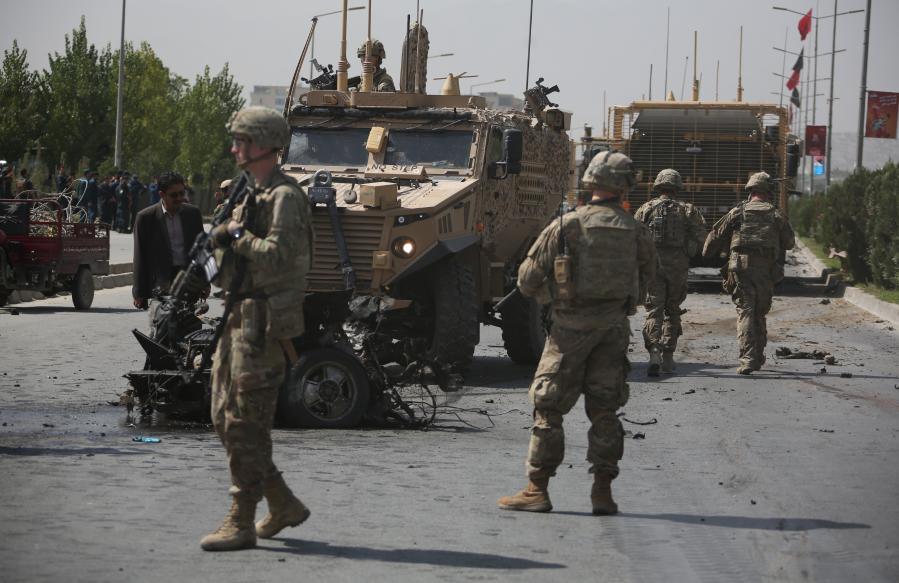
I was reminded of this paternalism once again with the recent phone call between Chinese President Xi Jinping and U.S. President Joe Biden, which the White House characterized as the U.S. “responsibly managing” its relationship with China, while still provoking in the South China Sea, still provoking with Taiwan, still trying to cobble together an international alliance against China, from NATO to the so-called Quad, composed of the U.S., Australia, India, and Japan, still provoking over COVID-19 origins, and still provoking over trade. And still killing kids in Kabul.
The author is a professor of politics at East China Normal University in Shanghai.